

Smart Server Room Monitoring
A unified view of the environment, power and operations
Bring rack inlet temperature, leaks, cooling, UPS, power distribution and door status together. When an exception occurs, operators can see its location, current state and handling record.
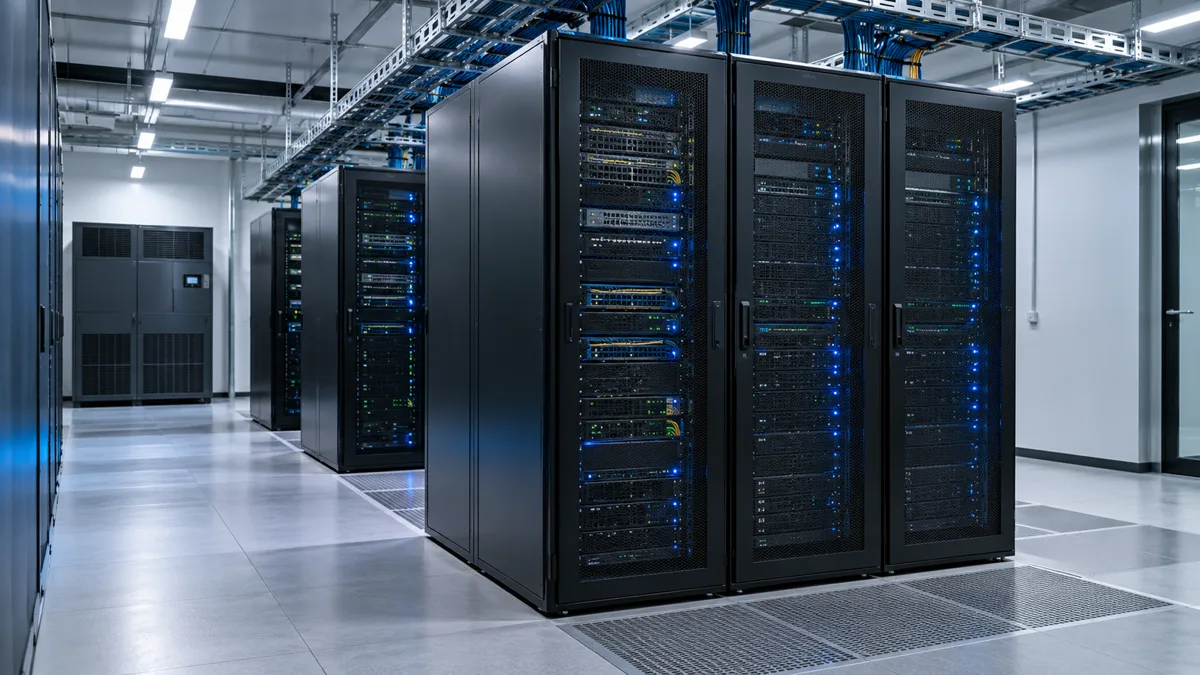
This design addresses three questions: Is the air entering the racks suitable? Are power and cooling operating normally? Where must staff attend? Field sensors and existing equipment interfaces provide data. The local platform collects it, records trends and routes alerts, while duty procedures govern acknowledgement and response. Final point locations, thresholds and interfaces depend on the site survey.
Configuration example for one six-rack server room
The example also assumes one distribution cabinet, six rack PDUs and one server room door. Two inlet temperature points, upper and lower, are estimated for each rack: 12 points in total. Four leak locations cover the two air conditioners and two low-lying or pipe-risk areas. Existing air conditioners, UPS units, PDUs and the fire system are monitored assets. Readable data depends on their interfaces and permissions.
01 · See server room operations in one view
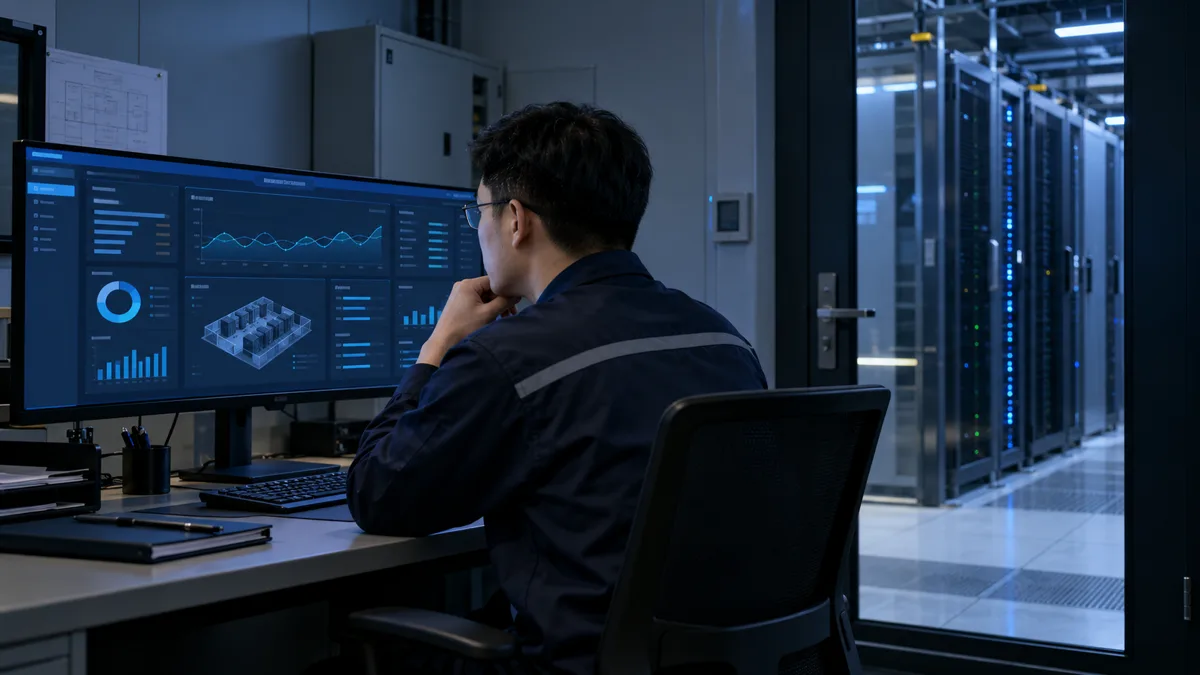
Environment, power and access status are organized by location. The local platform retains trends and events; role-specific screens show only the information each team needs.
02 · Organize monitoring around daily rounds
Start from the room location on the monitoring screen, then drill down to a device and its history. This reduces repeated device-by-device checks and inquiries.
Rack inlet
View upper and lower inlet temperatures and trends at the rack front to identify a single-rack or local hot spot.
Cooling operation
Summarize run, fault and communication states of the two air conditioners. Readable fields depend on their interfaces.
UPS and distribution
View available input, output, load, bypass and battery states in the context of the power chain.
Leaks and access
Map leak and door states to specific points to plan a site visit and inspection route.
Place temperature and humidity monitoring where air enters IT equipment, rather than relying on one average reading in the middle of the room. Set thresholds using equipment environmental classes, cold-aisle design and the operating baseline. For design context, see the ASHRAE data center facilities chapter。
03 · Record every step from alert to closure
Handle measured exceptions and communication failures separately. Locate the point first, inspect it, then confirm the response outcome.
equipment state triggers
or power point
and duty roster
and take action
and handling notes
For example, when upper inlet temperature at one rack remains above its threshold, the system identifies the rack and time, alongside other points in the same cold aisle and cooling status. The operator checks the sensor, airflow and IT load, then records the cause. The event retains its handling history after temperature recovers. Network loss or an offline sensor is alerted separately so missing data is not mistaken for normal conditions.
04 · Route different exceptions to the right team
Configure alert name, location, severity, recipient and action record together to reduce duplicate messages and missed responses.
Environment and leaks
For inlet temperature deviation, abnormal cold-aisle humidity or water near an air conditioner, show the point, trend and last update. Prioritize notification to facilities staff for leaks.
Power and offline equipment
Show the source and state of faults reported by distribution, UPS or cooling equipment. Treat communication loss as a separate event. Control actions require a separate review of equipment capability and authorization.
The base design focuses on monitoring, recording and notification. Power protection, fire alarms, emergency shutdown and precision cooling control remain with the original devices and dedicated systems. This platform does not automatically cut power or trigger fire actions.
05 · One data set for four roles
Each team sees what it needs to assess and act. Managers can review alerts and inspection outcomes.
Duty operator
See active alerts, room status and open issues; acknowledge and notify promptly.
Facilities staff
Check cooling, distribution, UPS and leaks; record repairs and recovery.
IT operations
Review rack inlet temperatures and related states alongside IT load.
Manager
Review trends, alert handling records and recurring unresolved issues.
06 · Equipment list: verified models and justified quantities
HAIOTS model numbers come from the supplied device list. Model cells remain blank for existing server room equipment and accessories without a listed model. Quantities below estimate a six-rack room.
Platform and duty terminal
| Product name | Model | Quantity | Purpose and selection reason |
|---|---|---|---|
| Professional smart controller | HA01 | 1 unit | Local hub for data integration and rules, with unified point, trend and alert management. |
| Central management platform | HMS | 1 set | The list says HA01 includes HMS; check the existing license before buying another. |
| 10.36-inch magnetic Android tablet | H1036 | 1 unit | Place in the duty room to show the room overview and open alerts; detailed administration can use a computer. |
| Tablet mounting and power accessories | 1 set | Specify for desktop or wall placement and verify the available power supply. |
Temperature, humidity, leaks and door status
| Product name | Model | Quantity | Purpose and selection reason |
|---|---|---|---|
| 8-channel NTC10K temperature input module | HA-NTC108 | 2 units | Twelve rack inlet points require two eight-channel modules, leaving four spare channels. Verify wiring distances and module distribution. |
| NTC10K temperature probe | 12 probes | One upper and one lower probe at the front of each of six racks measures air entering IT equipment. Match probes to module electrical specifications. | |
| Light, dew point, temperature and humidity sensor | HA AIR04 | 2 units | One in each of two cold aisles or representative zones for environmental and humidity trends. |
| Leak probe and sensing cable | 4 sets | One near each of two precision air conditioners and one at each of two low points or pipe-risk locations; adjust to drainage and piping. | |
| Magnetic door contact | 7 sets | Record six rack doors and one server room door separately. This does not replace access control. | |
| Single-channel dry-contact input module | HA DI01 | 11 units | One for each of four leak points and seven door contacts; count modules and sensors separately. |
Power and existing equipment integration
| Product name | Model | Quantity | Purpose and selection reason |
|---|---|---|---|
| Smart three-phase energy meter | HA-EM02 | Provisionally 1 unit | Monitor electrical values for one three-phase circuit in the distribution cabinet. Confirm the circuit, current transformers and wiring from electrical drawings. |
| RS485/RS232 network serial converter | HADTU439S | Provisionally 2 units | Reserve separate links for power and cooling equipment. Use only where existing devices expose a compatible interface and their protocols can be parsed. |
| UPS status interface | 2 groups | One for each of two existing UPS units. Read available states and alerts; confirm interfaces, registers or network cards from vendor documentation. | |
| Precision air conditioner status interface | 2 groups | One for each of two existing units to read operation and faults; confirm vendor interface and permissions. | |
| Rack PDU status interface | 6 groups, conditional | One per rack only if the existing PDU exposes status or electrical values. Do not assume a basic PDU is monitorable. | |
| Existing fire system status interface | 1 group, conditional | Display events only if the original system provides a lawful, usable read-only signal. Fire alarm and response remain with that system. | |
| Single-channel dry-contact input module | HA DI01 | 1 additional unit, conditional | Use only if the fire system provides a confirmed dry-contact status output; exclude it from the base eleven inputs. |
Power, network and installation materials
| Product name | Model | Quantity | Purpose and selection reason |
|---|---|---|---|
| DC power supply | Size by zone | Specify from sensor and module voltage, power draw, cable length and reserve. | |
| Switch and network ports | Size on site | Reuse the existing network if isolation and reliability are sufficient; add ports according to the device and port schedule. | |
| Backup power for the controller and network equipment | 1 group, sized by load | Provide short-term power to the monitoring host and essential communications; coordinate with the room UPS capacity and wiring. | |
| Control enclosure, terminals, cables and labels | 1 lot | Specify from cable routes, points and power conditions to support maintenance and handover. |
Product names and models reference HAIOTS materials; quantities are estimated for this example. The list excludes existing servers, UPS units, precision air conditioners, PDUs and the fire system, and shows no internal prices.
Adjust the list when site conditions change
- If the number of racks changes:Recalculate two inlet probes and one door contact per rack; group temperature modules by available channels and wiring.
- If the UPS, cooling unit or PDU has no open data interface:Retain the vendor alarm output or management screen where possible. Limit integration to verifiable states rather than listing unsupported details.
- If cable distances or floor zones increase:Add serial converters, power supplies and network ports based on topology, not just the total point count.
- If control integration is required:Review control permission, equipment protection and failure states separately. The base design only monitors and alerts.
07 · Deliver a traceable monitoring configuration
From point mapping to duty response, handover materials support inspection, maintenance and future expansion.
- Point and communication scheduleIDs, locations and interfaces for racks, cooling, UPS, distribution, leaks and doors
- Monitoring screens and trendsRoom overview, zone details, data timestamps and historical curves
- Alert and duty rulesThresholds, persistence, severity, recipients, escalation and silence policies
- Records and permissionsAcknowledgement, action, recovery, closure and role access
- Integration test recordProtocols, registers or event mapping, bad values and communication-loss handling
- Backup and operations documentsConfiguration backup, recovery steps, inspection sheet and expansion rules
08 · Accept the system against on-site events
Each test ties a real point to its screen display, notification recipient and final record.
Inlet temperature and trends
Check twelve probes and six rack positions. Simulate one point above threshold and verify trend, persistence and recovery records.
Leaks and open doors
Trigger four leak points and seven door contacts individually; verify location, notification, acknowledgement and closure.
UPS, cooling and distribution
Compare readable states with vendor screens. Verify a separate communication-loss alert without disrupting real power.
Duty and recovery
Test unacknowledged escalation, host restart, network loss, data recovery and configuration backup; verify complete alert history.
Technical references:ASHRAE data center facilities chapteremphasizes monitoring at equipment air intakes;Schneider Electric environmental monitoring informationlists temperature, humidity and leak risks. Set actual thresholds and interfaces from project equipment and site design documents.
Nature of solution: standardized design example. For similar needs, contact our professional solutions engineers to develop a tailored solution.


