

Smart Factory
Bring production, energy and auxiliary systems into one view
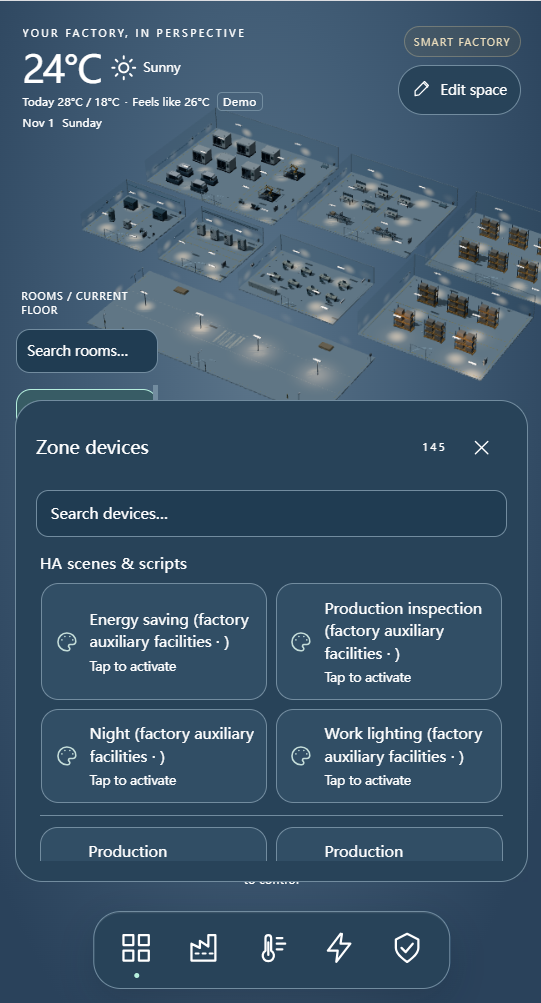
Bring production, assembly and packaging, raw materials and finished goods, compressed air, electrical rooms, offices and the factory environment into one spatial view. Managers can start with a zone, then review equipment status, operating feedback and incident records, giving inspection, collaboration and acceptance a clear entry point.
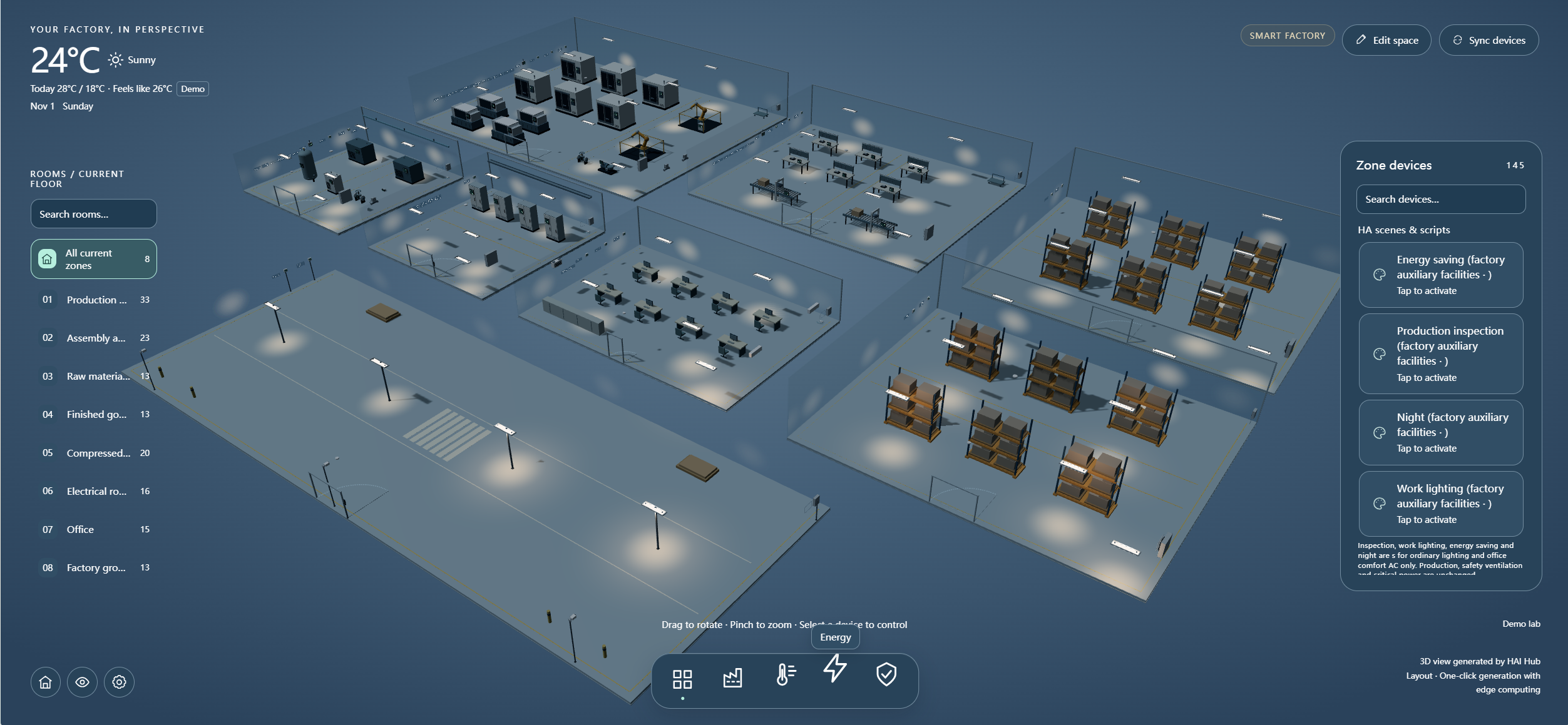
The design follows zone, equipment status, scene workflow and role collaboration. It suits factories that need a unified view of existing machines, instruments and control systems. It does not replace PLCs, interlocks, protection or process control. Enable writes or actions only after confirming protocols, permissions, interlock conditions and network-loss behavior on site.
Design basis · Organized around the demonstration space shown
Zone and entity counts come from the existing interface. Final purchase quantities, protocol gateways and point schedules must be verified against the site equipment list, registers, wiring and network topology.
01 · Unified architecture from zone to point
Locate the factory zone first, then open equipment, feedback and scenes, reducing the cost of seeing data without knowing where it belongs.
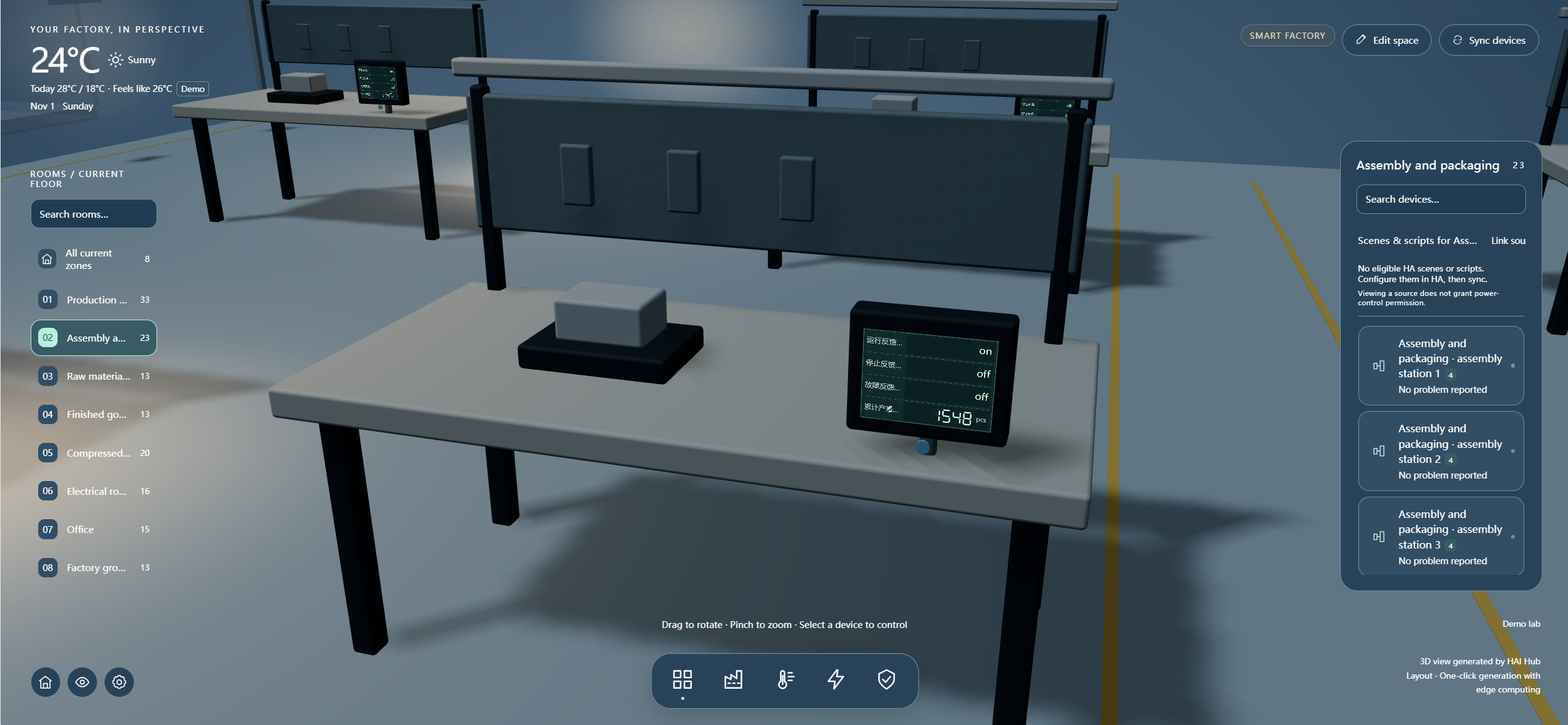
02 · Production and assembly: put feedback beside the station
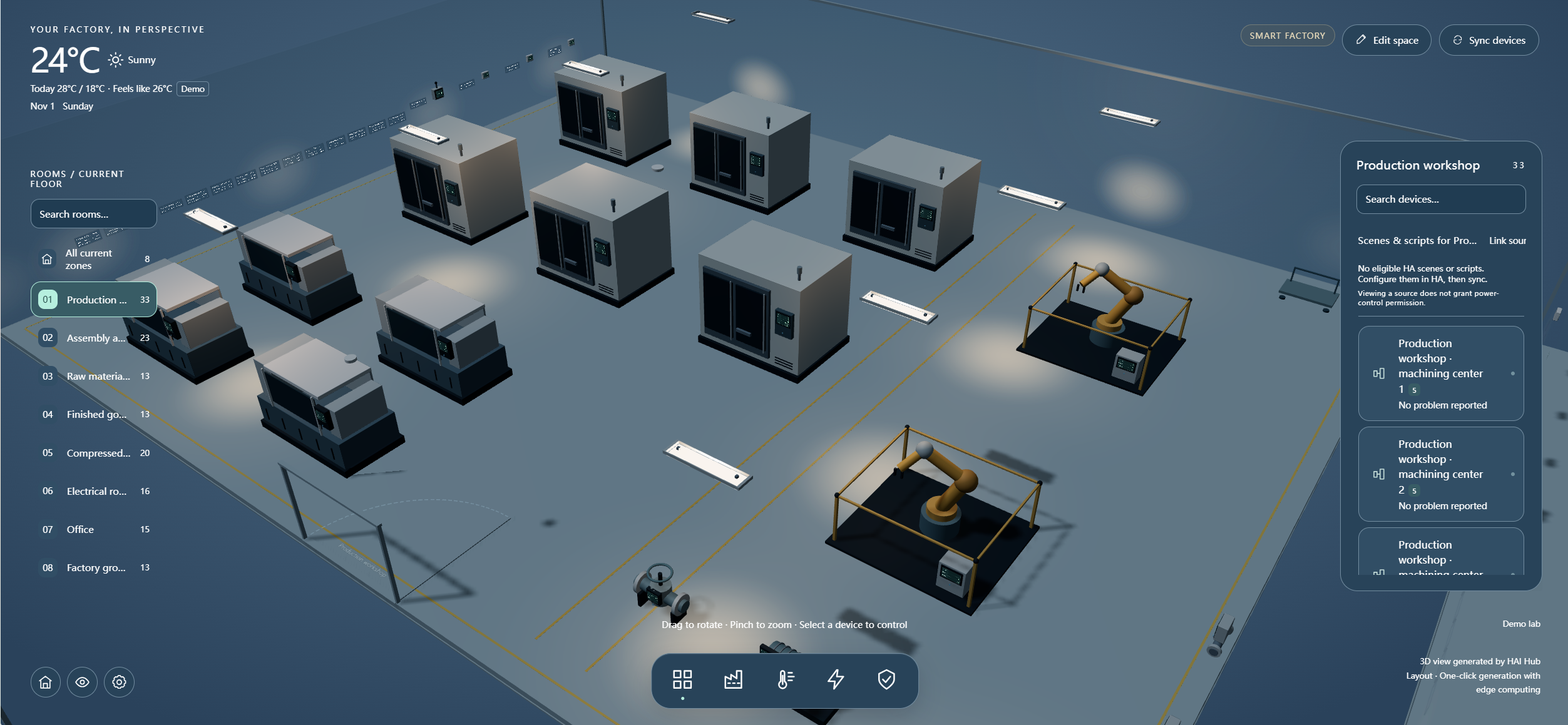
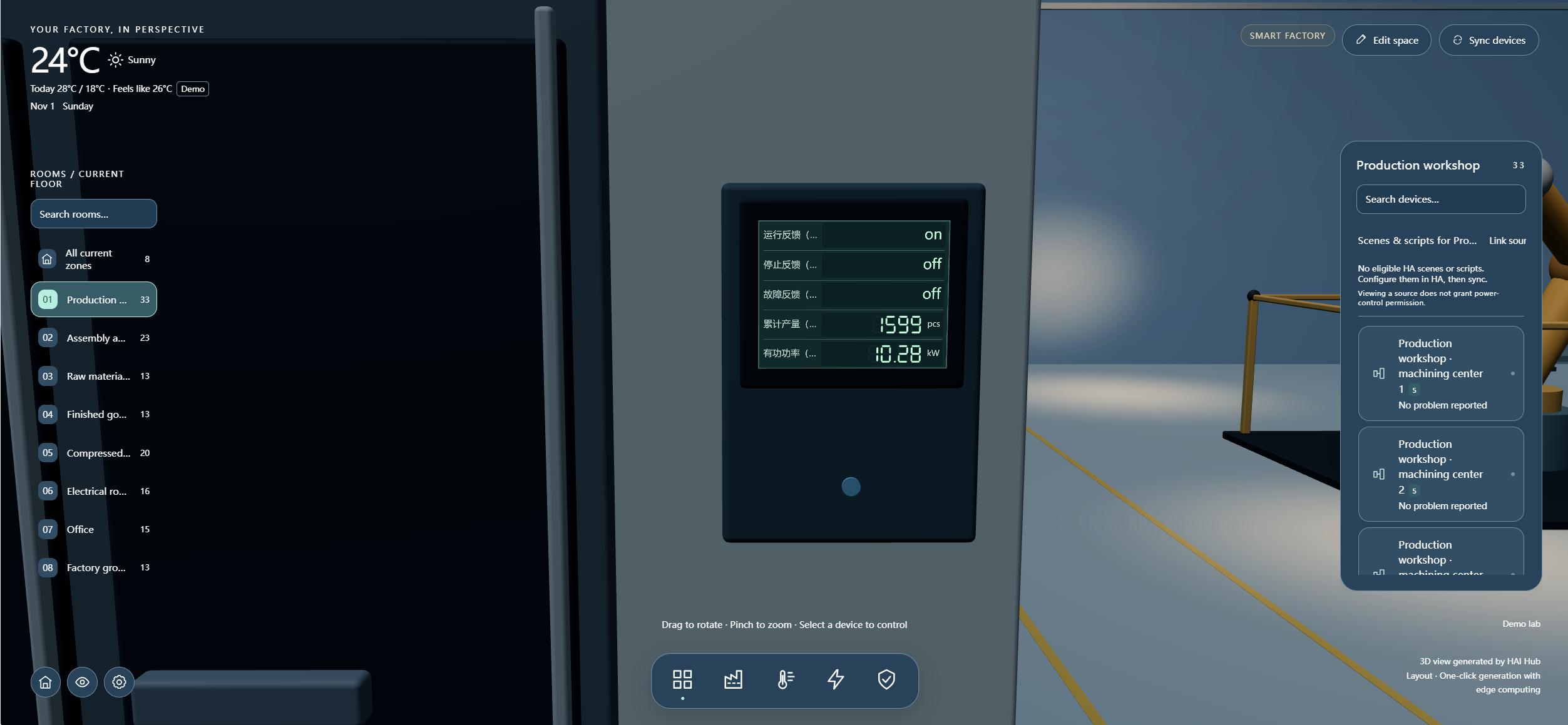
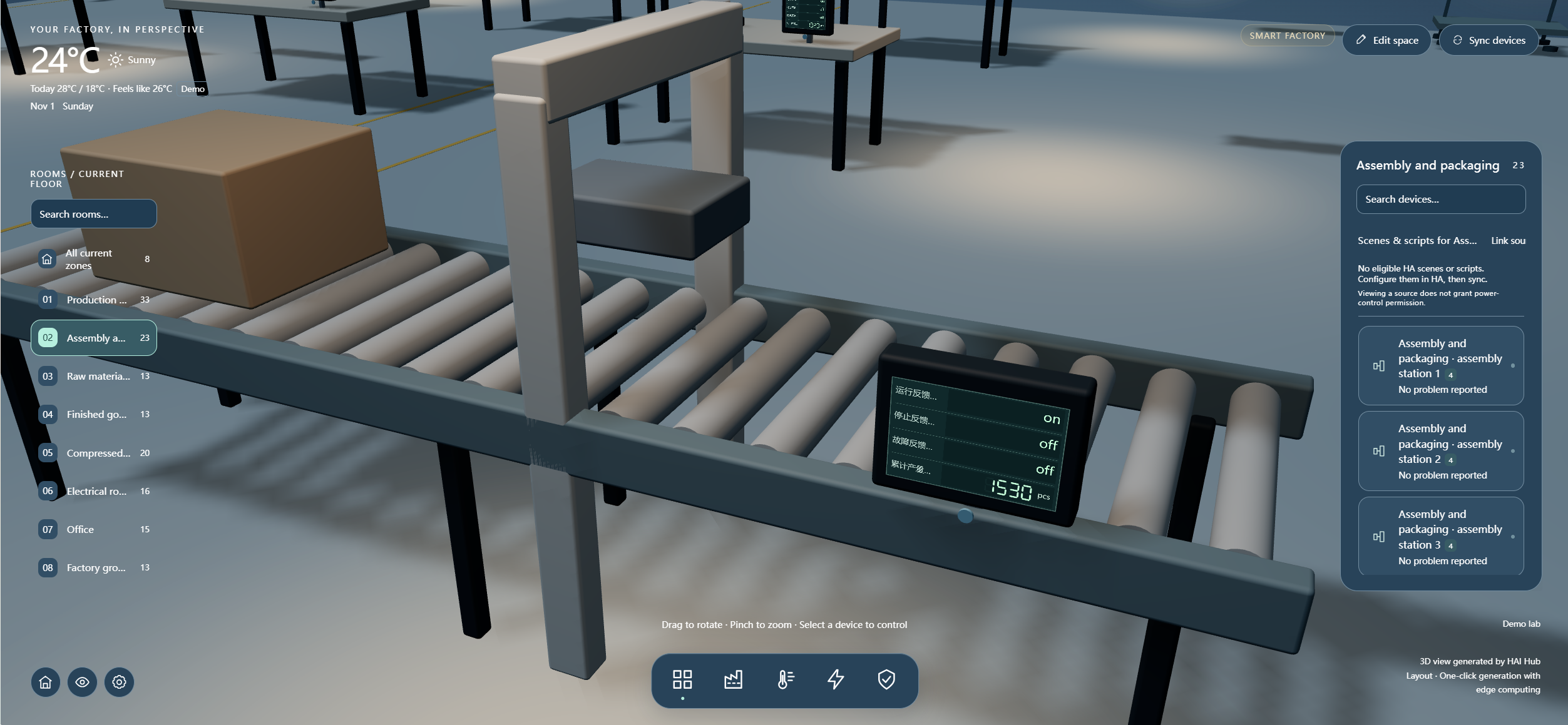
Open the production workshop or assembly and packaging zone from the overview to review entities, station status and data sources. Production and power readings in the screenshots are interface examples only.
03 · Energy management: from main meter to zone, equipment and unit output
Build submetering for electricity, water, compressed air and major auxiliary loads. Review consumption by site, workshop, line, equipment, shift and time period so incident detection, cause review and improvement verification form a closed loop.
Review lighting, standby loads and time schedules for factory auxiliary systems in one place, with human confirmation before execution.
Review equipment feedback, station status and open items by workshop and assembly zone.
Use schedules for non-critical auxiliary loads such as site lighting. Critical equipment is excluded from default actions.
Organize lighting and environmental equipment by zone for quick field verification.
One energy ledger answers four key questions
How much is being used, where it is used, when an abnormality occurs and whether an improvement truly reduces consumption. Comparisons use measured data with the same scope and period; no saving percentage is assumed.
04 · From discovery to verification: a traceable inspection flow
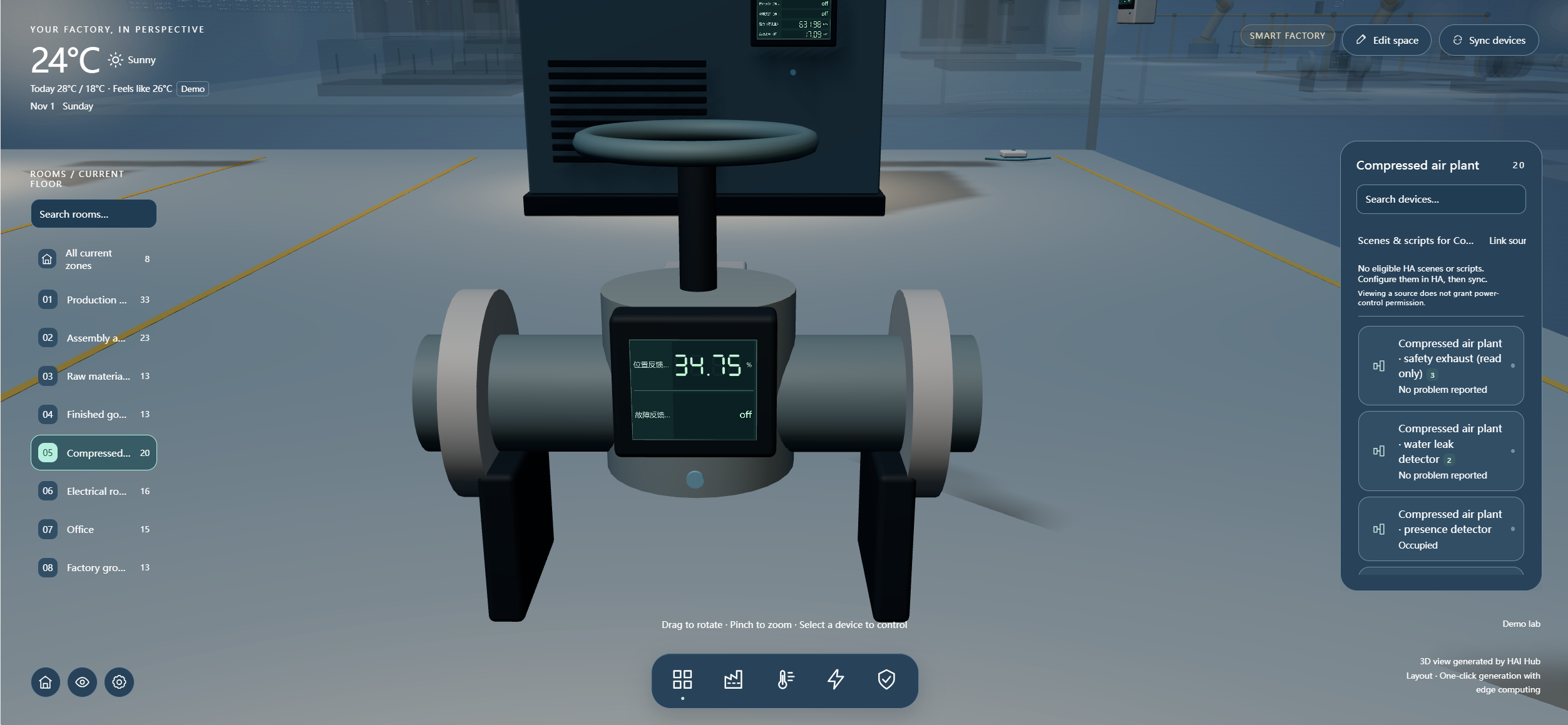
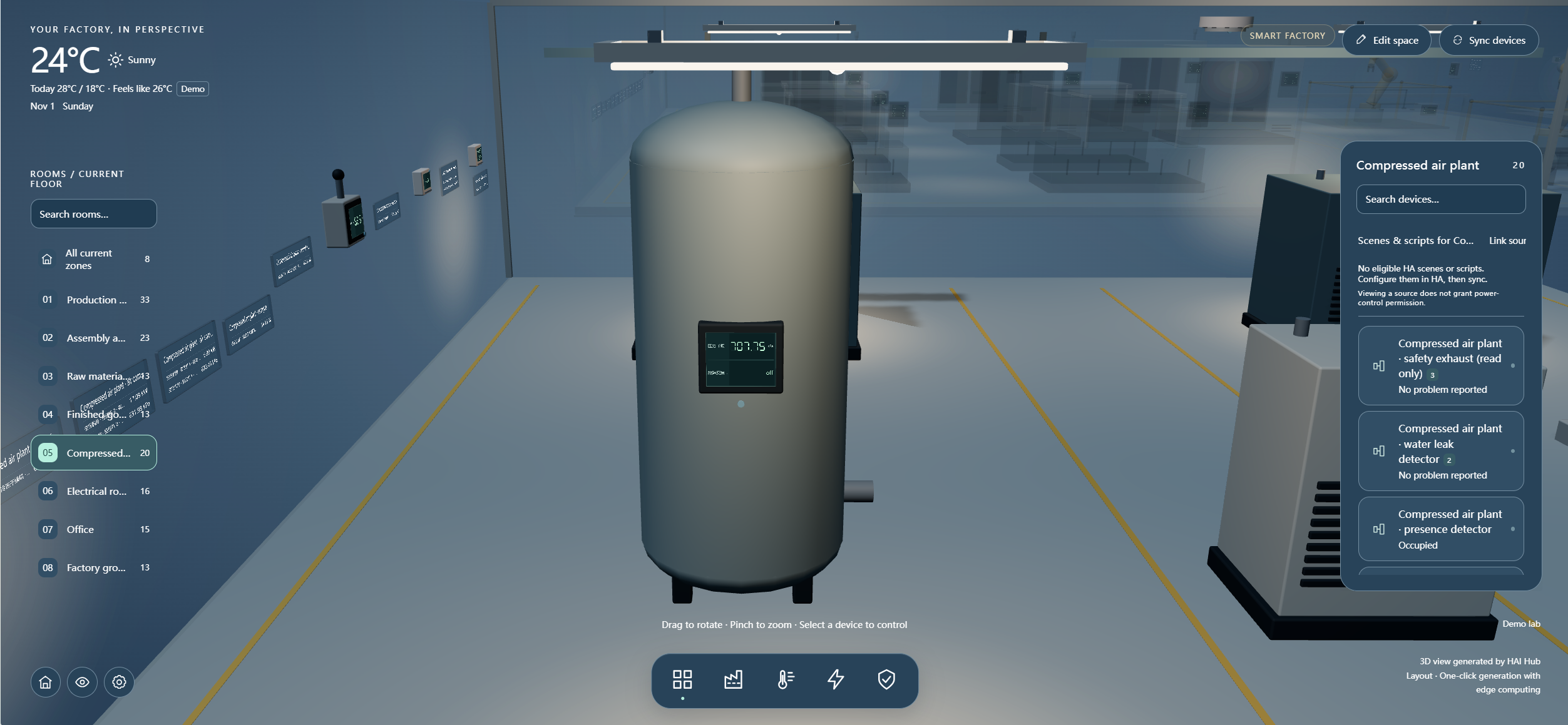
Turn visible status into an accountable workflow with recorded results.
Equipment-feedback incident
Run and stop feedback disagree, or a machine fault field changes.
Utility or environmental incident
Compressed air, water leak, presence detection or lighting status becomes abnormal.
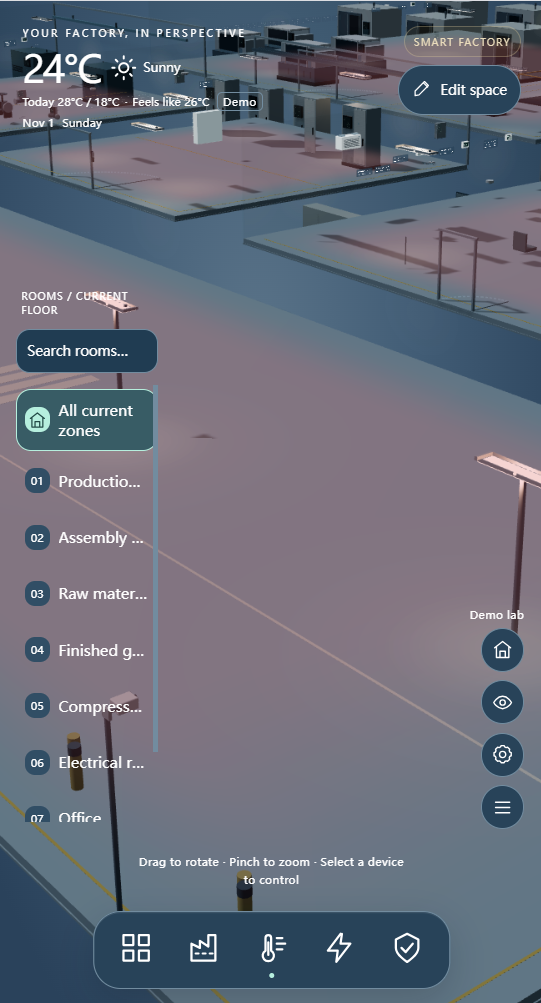
05 · Desktop and mobile: one spatial language
Desktop supports overview and point review; mobile supports field inspection and quick checks. Both retain the same zone, scene and equipment names.
06 · Configuration list · Implemented according to interfaces and site conditions
Unknown models are left blank. Quantities express a configuration basis or interface dependency; 145 interface entities are not treated as purchased devices.
Platform and communications
| Product name | Model | Quantity | Configuration use and selection reason |
|---|---|---|---|
| Enterprise IoT whole-site control hub gateway | HAI04 | 1 set | Unified entry point for factory spaces, devices, states, scenes and mobile views; suited to wired-network deployment. |
| HA01 professional smart controller | HA01 | 1 set, selected per project instead of HAI04 | Supports Modbus, RS485, RS232, dry contacts and HA Wi-Fi for projects requiring multiple interface types. |
| 128-point Modbus-to-HA gateway | HAMHB128 | Size by 128 points per gateway and total points | Aggregates Modbus points from PLCs, meters and controllers. Verify actual capacity against polling interval and register count. |
| 64-point Modbus-to-HA gateway | HAMHB64 | As required for smaller zones | Suitable for an independent workshop or utility room, avoiding concentration of every point on one link. |
| Serial-to-network TCP/MQTT gateway | HA-WF485 | Size by number of RS485 buses | Connects field RS485 devices to the IP network for cross-zone aggregation and maintenance. |
| RS485/RS232 network conversion module | HADTU439S | Size by serial device group | Connects serial devices through TCP, MQTT, UDP or HTTP. Verify field protocol and network policy before deployment. |
Production and assembly interfaces
| Product name | Model | Quantity | Configuration use and selection reason |
|---|---|---|---|
| Single-channel DI dry-contact input module | HA DI01 | Quantity of run / stop / fault contacts required | Converts dry-contact states from original equipment into platform points, preferably read-only without changing machine logic. |
| Integrated magnetic temperature and vibration sensor | HA JTZ01 | As required for critical motors, fans, pumps and rotating equipment | Captures temperature and vibration trends where equipment health cannot be read directly. |
| 0–450°C wall-mounted high-temperature sensor | HA JTS01 | As required for high-temperature equipment or process points | Captures process-temperature trends near drying, heating or hot surfaces. |
| Smart infrared temperature probe | HAWTS500 | As required where contact measurement is impractical | Provides non-contact temperature data for moving parts or points unsuitable for wired contact sensors. |
| Color-recognition and sorting industrial-vision sensor | HA RGBCS03 | As required at sorting stations | Supports color recognition and sorting-position assistance. Use for quality decisions only after process validation. |
| 10 mm displacement sensor | HADS50 | As required for displacement or in-position detection | Provides measurable feedback for fixtures, stations or mechanisms; the range must match the field movement. |
| 24-circuit high-power 16 A relay module | HA-M24162 | As required for auxiliary-system circuits | Central control for non-critical auxiliary circuits such as lighting. Production and safety-critical loads are excluded by default. |
Utilities, energy and environment
| Product name | Model | Quantity | Configuration use and selection reason |
|---|---|---|---|
| 0–1 MPa Modbus pressure transmitter | HAPS03 | At least one main-pipe point; add critical branches as required | Measures compressed-air main and branch pressure. Confirm range, connection size and thresholds on site. |
| Split duct air-speed and airflow transmitter | HA JFS01 | As required for exhaust or supply ducts | Captures factory ventilation and equipment-exhaust status. Confirm duct size, straight-run requirements and range. |
| High-accuracy differential-pressure transmitter | HA JPDS01 | As required for filters, clean areas or ducts | Tracks filter and zone differential pressure without replacing original process protection or interlocks. |
| Smart three-phase energy meter | HA-EM02 | As required for main distribution and critical three-phase circuits | Collects voltage, current, power and cumulative energy for workshop and utility submetering. |
| Single-phase 2P smart meter with RS485 | HA EM14 | As required for office, lighting and other single-phase circuits | Adds single-phase submetering. Remote switching is enabled only after permissions and electrical design are confirmed. |
| Ultrasonic flow meter | HA-UF600 | As required for critical cooling-water or process-water pipes | Clamp-on measurement simplifies retrofit. Confirm pipe material, diameter and straight-run conditions before installation. |
| Seven-in-one air-quality monitor | HA-AIR7S | As required for offices, duty rooms and critical workshops | Combines temperature, humidity and multiple air-quality indicators for environmental dashboards and ventilation reference. |
| Noise sensor | HA-NS01 | As required for high-noise workshops or the site boundary | Supports noise trends and inspection records; determine placement from the field sound environment. |
| Photoelectric smoke alarm | HA SD05 | As required for auxiliary monitoring points outside fire-system linkage | Provides an auxiliary smoke-status input and does not replace the legally required fire-alarm system. |
| High-mount presence sensor | HA-MBS42 | As required for high-bay workshops, warehouses or passages | Provides presence status for lighting and inspection scenes. Verify mounting height and coverage on site. |
| People-counting and presence sensor | HA-MBS51 | As required at main entrances | Provides zone occupancy and presence reference for offices, warehouse entrances and evacuation-support dashboards. |
| Two-channel 0–10 V dimming and speed-control module | HA-PD102 | As required for lighting or auxiliary variable-speed circuits | Adjusts non-critical lighting and fans through analog signals; verify load interface and loss-of-connection behavior. |
| Single-channel 20 A socket module | HA-R116 | As required for office and auxiliary-equipment sockets | Controls and monitors authorized auxiliary sockets; not for production machines or safety-critical loads. |
Adjust the list when site conditions change
Equipment brands, protocols, circuit counts, network isolation and existing control systems directly affect gateways, acquisition modules, points and installation work. Alternatives are not added together; final quantities follow site survey and commissioning.
07 · Delivery and acceptance · Close with verifiable results
Delivery covers more than a page going online. Equipment sources, incident paths and network-loss strategies must be verifiable.
-
Spaces and naming
Map all eight zones, equipment names, owners and permissions. -
Communications and points
Verify protocol, unit, read/write direction, refresh cycle and source point by point. -
Production and assembly commissioning
Compare run, stop, fault and cumulative values with original equipment screens. -
Energy and compressed-air commissioning
Compare main and submeter readings, equipment power, energy, flow, pressure and totals; establish equivalent shift, daily and monthly energy baselines. -
Mobile inspection
Mobile zone filters, device cards and scene names match the desktop view. -
Document handover
Deliver point schedules, network topology, energy-metering hierarchy, report definitions, permissions, change records and training records.
After original equipment state changes, the platform matches within the agreed refresh cycle.
Each incident records its zone, point, time, owner and response result.
Main and submeters close within the agreed tolerance; unit-product energy can be verified when shift and output data use the same basis.
Record behavior after network loss, reconnection and device restart.