
Smart Greenhouse
Bring climate, fertigation and equipment into one view
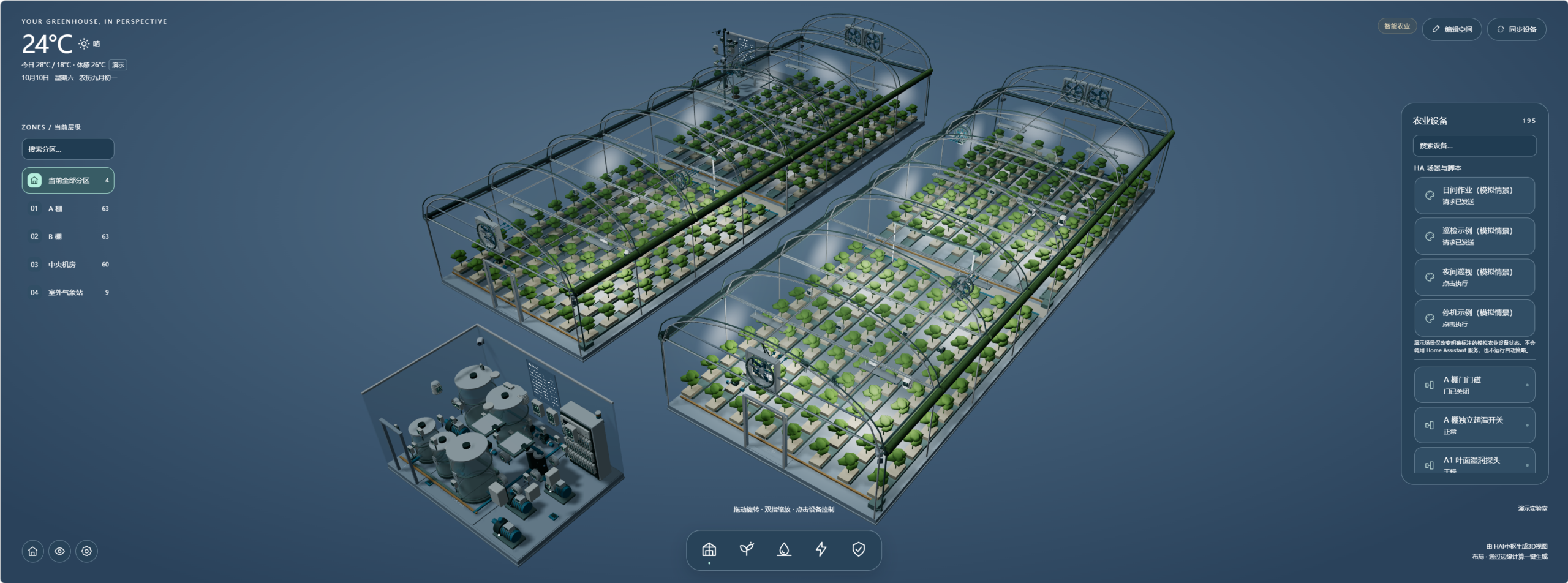
Using two greenhouses, A and B, a central utility room and an outdoor weather station as the design basis, this solution brings greenhouse sensing, irrigation and fertigation, ventilation and shading, and incident response into one interface. Growers locate equipment on a phone while managers check the whole site on a computer.
Greenhouse operations are often split among climate controllers, fertigation machines, pump panels, valves and manual inspection logs. This solution links equipment location, the source of each reading, confirmation of an action and responsibility for incidents in a traceable chain. Existing protection and local control stay with the original systems.
01 · Design basis: two greenhouses, one utility room and one weather station
Define a measurable demonstration scope first, then adjust quantities for growing area, zones and existing equipment interfaces.
The estimate assumes one representative climate monitoring zone and one irrigation branch per greenhouse. Temperature gradients, crop types, growing area and existing circuit counts may require more points. The 195 agricultural equipment entities shown in the screenshot are interface entities, not 195 physical devices or a procurement quantity.
02 · From field equipment to management view: four layers
Field data needs a source and timestamp before it enters zone and management views.
The platform sends control requests only to circuits authorized by the equipment maker, with verified interfaces and tested site interlocks. During network loss, sensor failure or communication interruption, pumps, fans, curtains and fertigation machines follow the original control system’s safety policy.
03 · See the zone first, then locate the equipment
The 3D space connects zones, equipment lists and actual mounting locations, reducing the time spent finding a point across systems.
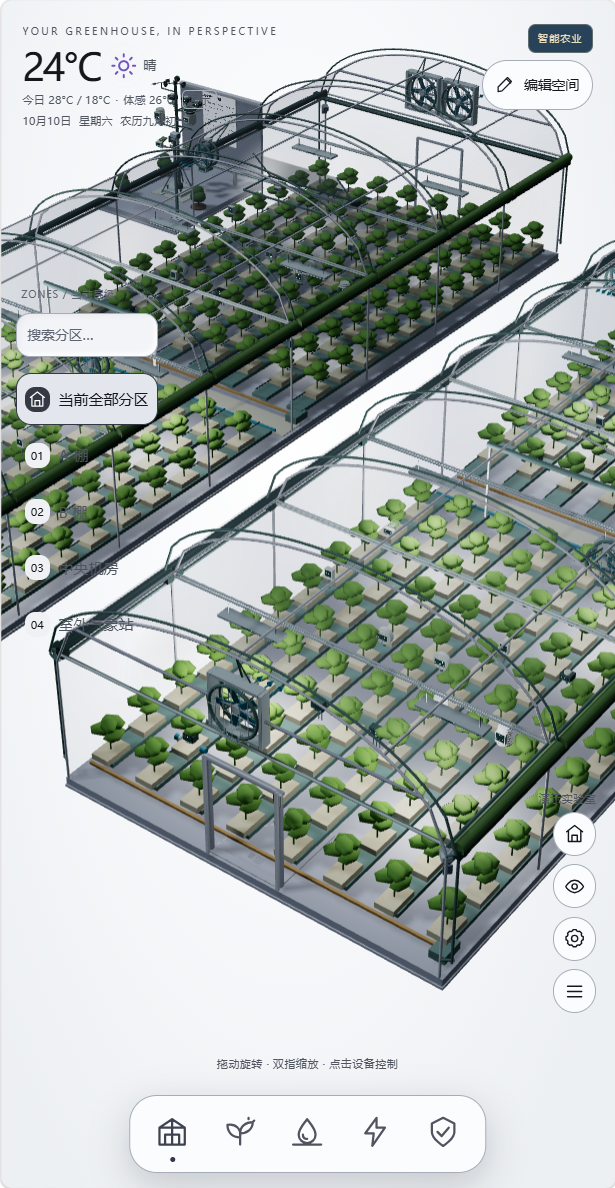
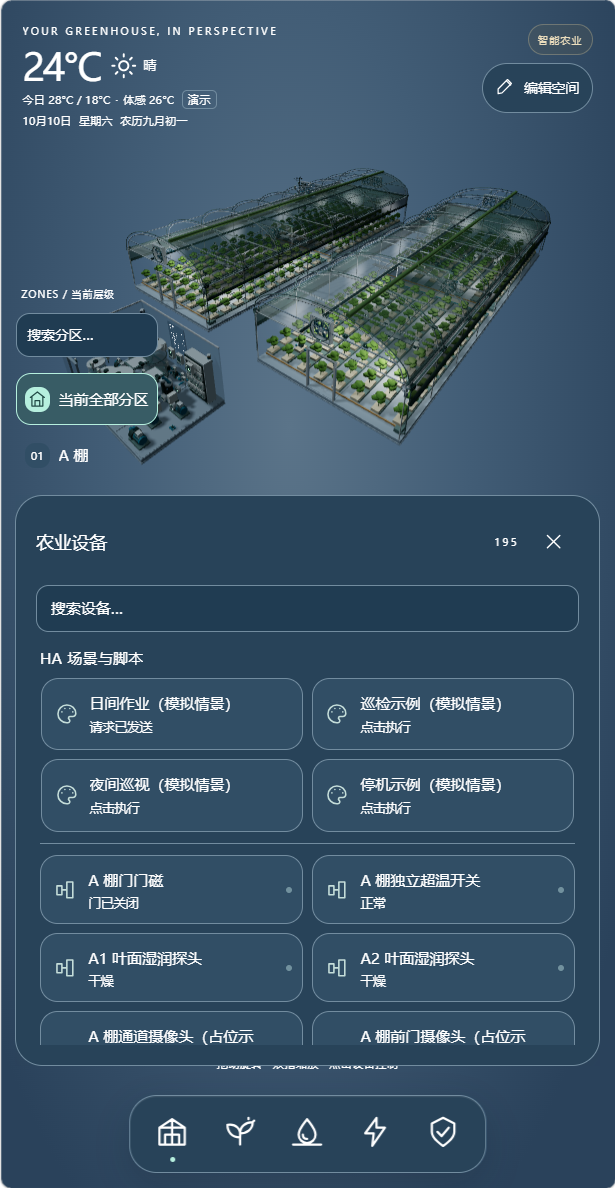
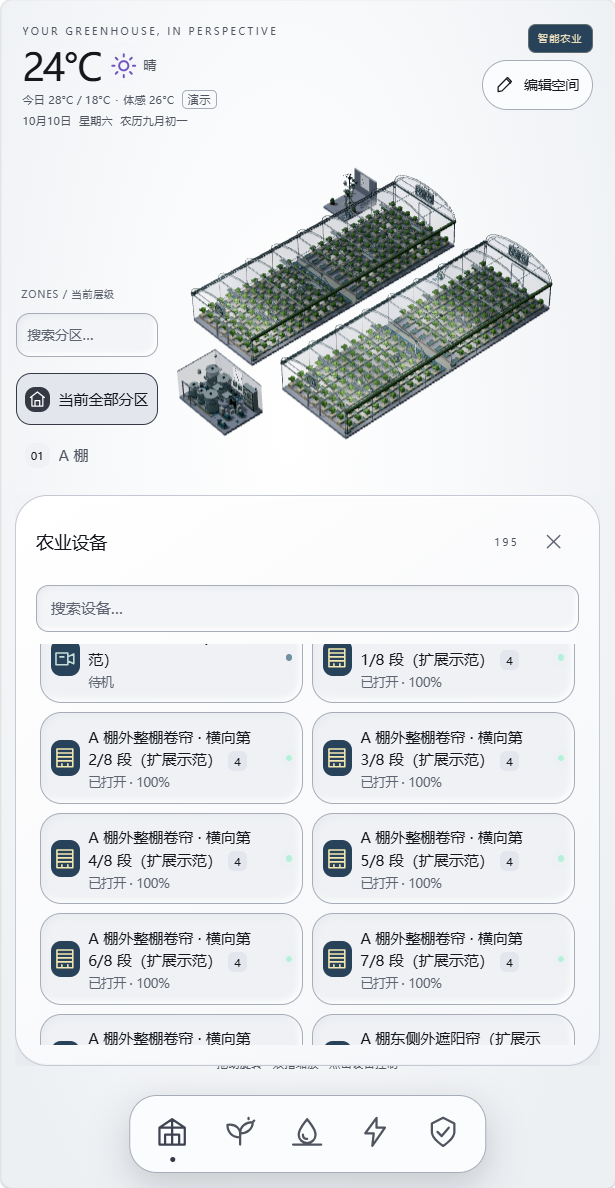
Choose Greenhouse A, Greenhouse B, the utility room or the weather station.
Locate it by position or device name.
Verify reading, update time and fault feedback.
After requesting an operation, verify the result and record the response.
04 · Sensing: align indoor climate, irrigation and outdoor weather
A reading is useful for management only when tied to the crop zone, measurement location and sampling time.
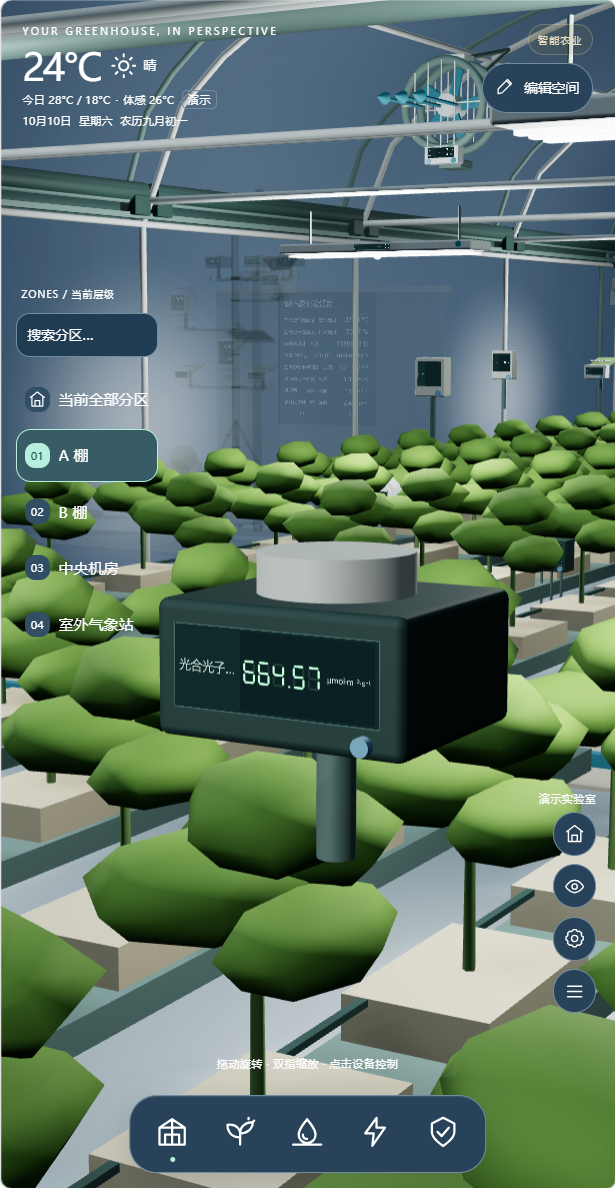
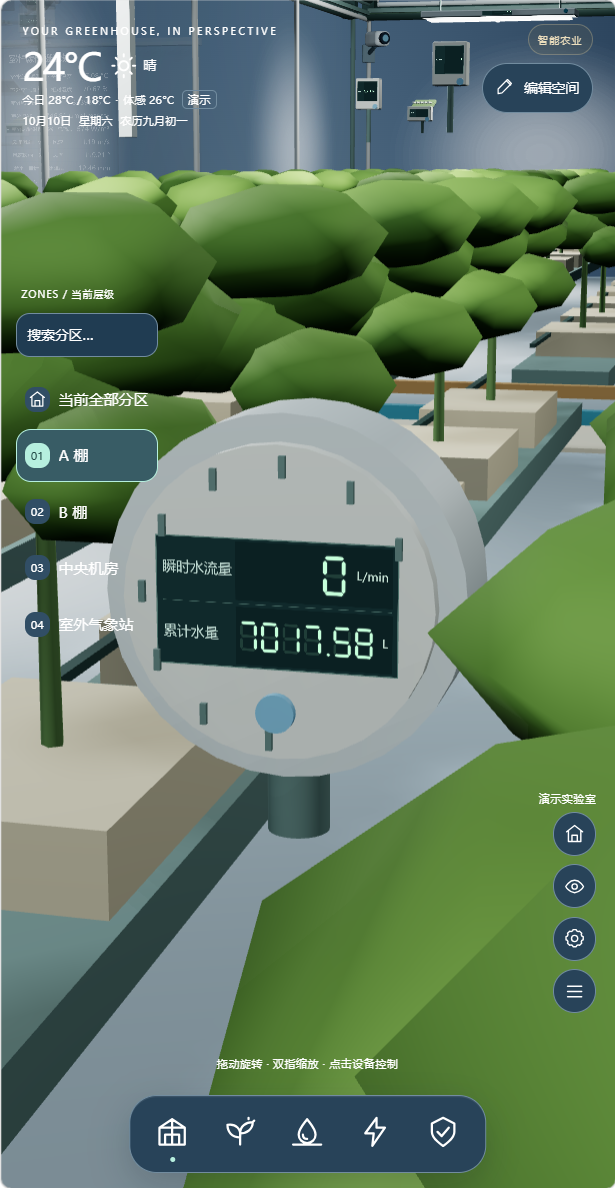
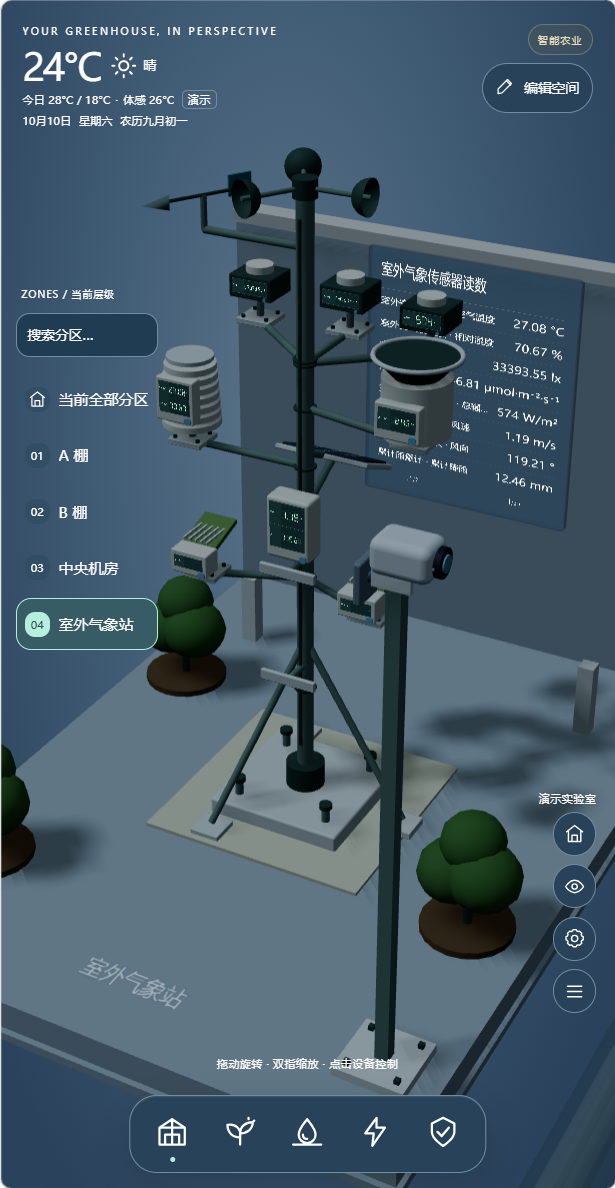
Greenhouse microclimate
View air temperature, humidity, light and leaf wetness by greenhouse. Alerts should show point, threshold, duration and offline status.
Irrigation branch
Compare valve opening, pump status, flow and cumulative water. If a valve is open but flow is zero, prompt a person to check the source, pump and piping.
Outdoor weather
Use local measurements for wind and rain actions; curtains and ventilation remain subject to original limits, wind policy and manual takeover.
05 · Fertigation room: see commands and feedback
Put pumps, mixing, pressure, nutrient-solution status and recipe jobs into one work chain.
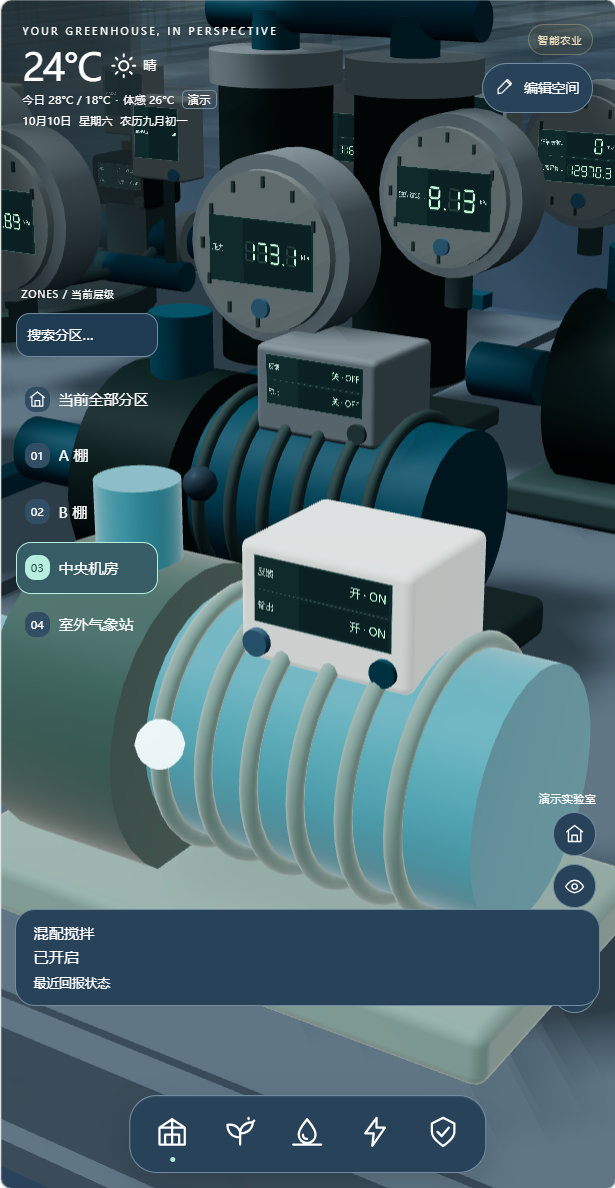
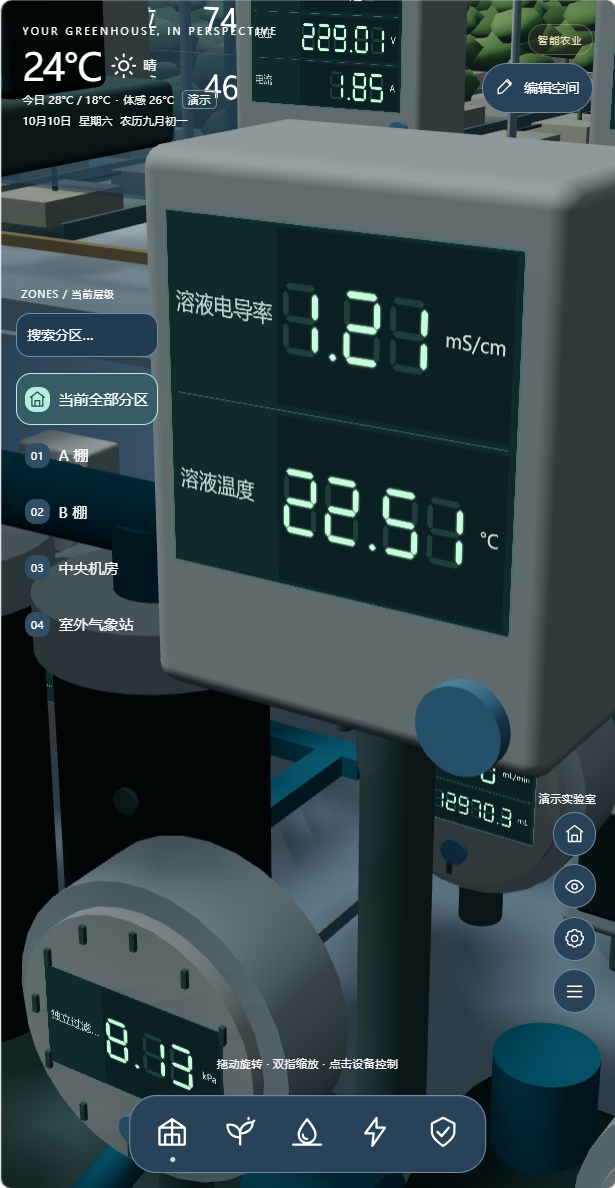
An agronomist should set target nutrient-solution EC for the crop variety, growth stage, water quality and fertilizer. This design does not set one universal crop threshold. Camera feeds and leaf-moisture placeholders become usable functions only after physical devices and lawful data interfaces are in place.
06 · Four daily scenes and incident response
Each scene distinguishes a request from confirmed equipment action.
Day work
Check greenhouse light, climate and irrigation tasks. Trigger authorized ventilation, shading or fertigation plans and record original-controller feedback.
Night inspection
Watch temperature deviations, disconnected devices, doors and pump-room incidents; the duty operator checks location and response by zone.
Wind and rain response
The weather station supplies wind and rain signals; the original curtain or skylight controller decides whether action is permitted. The platform shows requests, interlock rejection and final state.
Shutdown and maintenance
Confirm isolation and manual takeover before maintenance. The platform records why equipment stopped, who repaired it and acceptance after recovery; it does not replace physical lockout and tagging.
Show branch, valve feedback, pump status, flow update time and related alert. The duty operator checks source water, filter, pump and sensor, then records the cause and remedy. Unverified automatic catch-up irrigation is not a default action.
07 · Example equipment and interface list
Quantities assume two greenhouses with one representative monitoring zone and one irrigation branch each. Product models appear only when verified in the existing catalog.
Platform, communications and interface
| Product name | Model | Quantity | Configuration use and selection reason |
|---|---|---|---|
| Enterprise IoT whole-site control gateway | HAI04 | 1 unit | Local mapping, rules and interface hub in the utility room; verify point capacity, power, network and environment on site. |
| HA central management platform | HMS | 1 set; check license | Manage multiple greenhouse zones, roles, events and configurations; check existing controller licensing to avoid duplicate charges. |
| RS485/RS232 serial-to-network module | HADTU439S | Provisionally 2 units | Provisionally one per greenhouse for open serial devices; verify protocol, registers, distance and power individually. |
| Site network and backup power | 1 group; size on site | Connect both greenhouses, utility room and weather station; original equipment must keep local control and protection during network loss. |
Environmental and weather sensing
| Product name | Model | Quantity | Configuration use and selection reason |
|---|---|---|---|
| Light, dew-point, temperature and humidity sensor | HA AIR04 | Provisionally 2 units | One representative point per greenhouse for light and air climate; adapt enclosure, condensation protection and measurement range. |
| Leaf temperature and humidity sensor | Optional 2 units | One representative crop-layer point per greenhouse; helps observe leaf-wetness risk but does not diagnose disease. | |
| Temperature, humidity, conductivity, pH and NPK acquisition device | HASOIL05 | Optional 2 units | Only for soil or substrate monitoring where sensing principle, range and calibration fit; not a nutrient-solution EC probe. |
| Weather-station rain sensor | HA-RFS05 | Optional 1 unit | One rain input for wind-and-rain actions; wind and radiation need suitable separate devices. |
| Other outdoor weather sensors and acquisition interfaces | 1 group; size to installed equipment | Choose based on actual wind, climate, light and rain measurements; screen parameters are not evidence of purchased hardware. |
Irrigation, fertigation and energy
| Product name | Model | Quantity | Configuration use and selection reason |
|---|---|---|---|
| DN20 remote valve-control water meter | HA WMD20 | Optional 2 units | One per greenhouse branch for cumulative water, only if pipe diameter, pressure, flow range and valve-control needs match. |
| Modbus pressure transmitter | HAPS03 | Provisionally 1 unit | Measure utility-room main pressure; verify medium, threaded fitting and range before connection. |
| Submersible level transmitter | HA-SLS20 | Optional 1 unit | Example level point in stock-solution or water tank; check vessel material, depth and medium compatibility. |
| Nutrient-solution EC and temperature interface | 1 group; reuse first | Prefer readings from the existing fertigation controller’s calibrated probe; design separate sampling only if no open interface exists. | |
| Existing fertigation unit, pump and irrigation-valve interface | 1 utility room + 2 branches | Reuse original controllers, interlocks and protections; connect only authorized status and command interfaces to the platform. | |
| Smart three-phase energy meter | HA-EM02 | Optional 1 unit | Monitor three-phase electricity in the utility room; an electrician verifies distribution, current transformers and installation. |
Actuation and delivery support
| Product name | Model | Quantity | Configuration use and selection reason |
|---|---|---|---|
| Existing ventilation, curtain and shading controller interface | Two greenhouses; size to installed circuits | Keep limits, anti-pinch, wind-and-rain interlocks and manual controls. Connect to the unified interface only after checking the original interfaces. | |
| Point list, scene rules and configuration backup | 1 set | Record device location, signal source, thresholds, permissions, action conditions, versions and recovery steps. |
This is a solution estimate. It excludes greenhouse structures, existing fertigation machines, pumps, fans, curtains and piping; internal prices from the attachment are not used. Adjust for other protocols, pipe diameters or existing sensors based on equipment data and commissioning results.
08 · Delivery and acceptance: make status traceable
Deliver not only an interface but also points, permissions, action boundaries and failure-recovery methods.
Greenhouse device-location plan, point list, communication mapping, role permissions, alert rules, backups and training.
Compare each instrument reading; test high and low thresholds, offline state, timestamps and recovery messages.
Check valve request and feedback, pump status, water volume, pressure and EC; simulate zero flow and probe failure.
Test original controller limits and interlocks on site. After network loss, verify local operation, manual takeover and data recovery.
Solution type: standardized design example. For similar needs, contact our solution engineers for a design tailored to you. All nine images are interface screenshots from an existing case solution.